Artistry
Gel vs. Acrylic Nails: Which Is Actually Better for Your Natural Nails?
Few beauty treatments are as instantly transformative as a fresh set of nails. Whether it is a sheer, barely-there manicure or dramatic extensions, gel and acrylic systems have made it possible to change the length, shape, strength, and appearance of natural nails in a single appointment. But beneath the glossy finish is a question that many clients eventually ask: Which is actually better for my natural nails—gel or acrylic? The answer is more complicated than declaring one product “healthy” and the other “damaging.” Both gel and acrylic nail systems rely on acrylate or methacrylate chemistry to create strong artificial coatings or enhancements. Both can be worn without significant problems when appropriate products are applied correctly, maintained properly, and removed carefully. And both have the potential to contribute to nail damage, irritation, or allergic reactions when technique goes wrong. In many cases, the condition of your natural nails after an enhancement has less to do with whether you chose gel or acrylic and more to do with how the enhancement was applied, maintained, and removed. Here is what is actually happening underneath your manicure. ---
Stay Informed
A better inbox starts here.
Get thoughtful beauty and wellness guidance from the Aledore Journal.
Find Locally
Find trusted providers near you
Acrylic Nails
Traditional acrylic enhancements are generally created by combining a liquid monomer with a polymer powder. When the nail technician dips a brush into the liquid and then into the powder, the two components form the familiar acrylic bead. That bead is shaped over the natural nail or an extension and begins polymerizing. In other words, it hardens through a chemical reaction without requiring a curing lamp. The U.S. Food and Drug Administration explains that artificial nails are primarily composed of acrylic polymers and may involve methacrylate monomers. Once the polymerization reaction is complete, small amounts of unreacted monomer can remain. That distinction matters because the fully formed polymer is generally much less reactive than the monomers used to create it.
Gel Nails
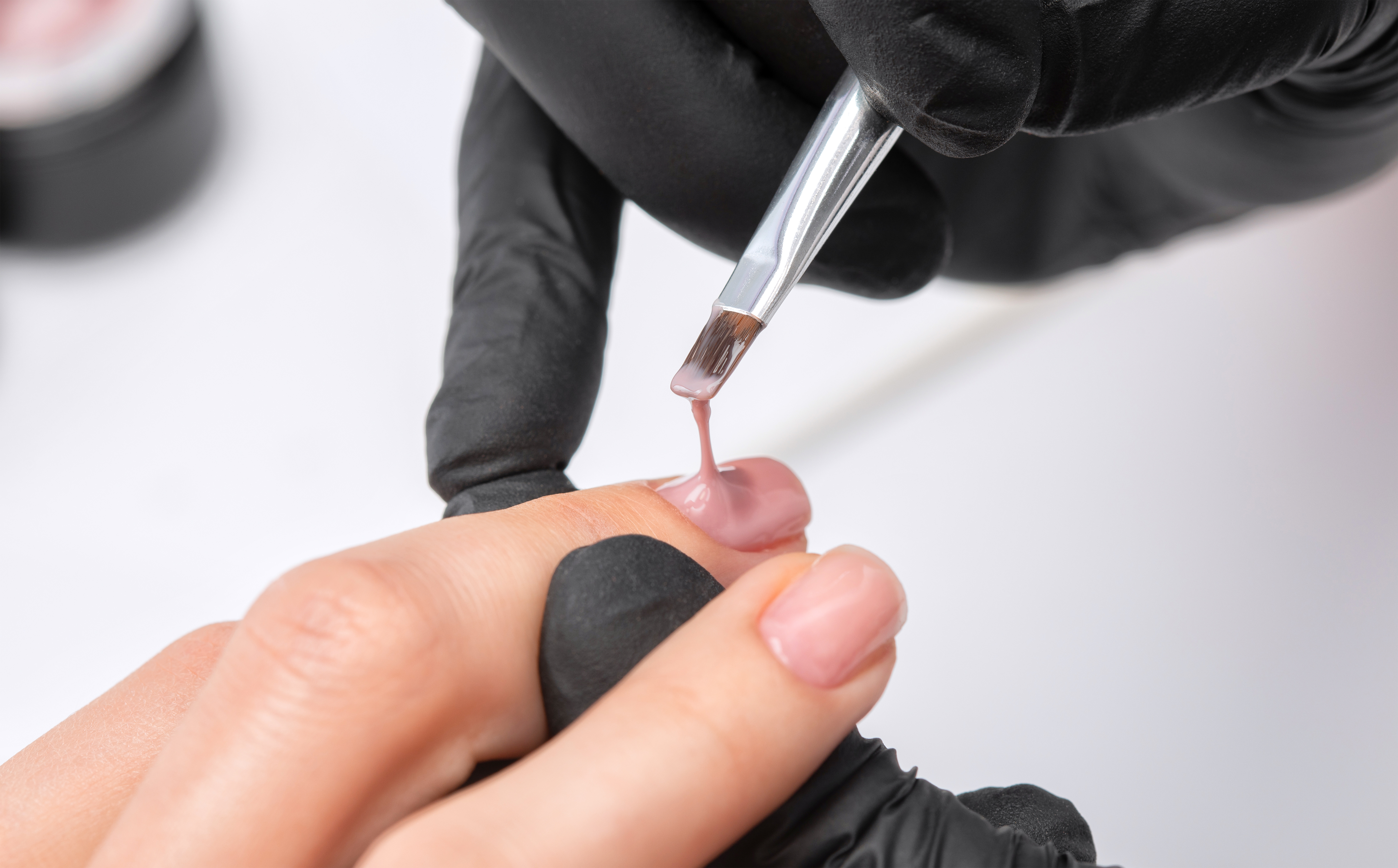
Gel systems arrive in a different form. Rather than mixing a separate liquid and powder at the nail table, gel products contain ingredients formulated to remain workable until they are exposed to the appropriate curing light. A UV or LED nail lamp initiates polymerization, transforming the gel from a liquid or semi-liquid material into the hardened coating we recognize as a gel manicure. And an important clarification: An “LED lamp” does not necessarily mean there is no ultraviolet exposure. Many modern LED nail lamps cure gel by producing wavelengths in the UVA portion of the ultraviolet spectrum. “LED” describes the technology producing the light; it does not automatically mean the light itself is UV-free.
Gel Polish, Builder Gel and Hard Gel Aren't Exactly the Same
The word “gel” has become an umbrella term. Someone saying, “I have gel nails,” could be describing several different services.
Gel Polish
Gel polish is generally a relatively thin coating applied similarly to traditional nail polish and cured between layers. Its primary purpose is long-lasting color rather than dramatically changing the architecture of the nail.
Builder Gel
Builder gels are thicker and can provide additional structure and strength. Depending on the product, they may be used to reinforce the natural nail or create additional length.
Hard Gel
Hard gels can create more substantial overlays and extensions and are typically designed to be filed rather than completely dissolved with acetone. This distinction becomes important when discussing removal. Not every gel product is a “soak-off gel,” and treating every gel system as though it can simply be wrapped in acetone can result in unnecessary scraping, filing, or damage.
What Actually Damages the Natural Nail?
This is where the gel-versus-acrylic debate becomes misleading. People frequently blame the product when the real culprit may be the process surrounding the product. The natural nail plate is composed primarily of layers of keratinized cells. It is strong enough to protect the fingertip but can become thinner, rougher, more brittle, or prone to splitting when repeatedly traumatized. Several parts of an enhancement service can contribute to this.
1. Aggressive Nail Preparation
Before gel or acrylic is applied, the nail surface usually needs some preparation. The goal is to remove contaminants and create an appropriate surface for adhesion. But there is an enormous difference between lightly preparing the surface and aggressively removing layers of the natural nail. Excessive hand filing or e-file use can thin the nail plate before the enhancement has even been applied. That can leave nails feeling: A client may later believe, “Acrylic ruined my nails,” when some of the damage actually occurred during preparation. The same can happen with gel.
- thin
- tender
- flexible
- sensitive
- weak
- prone to splitting
2. Peeling or Picking the Product Off
One of the worst habits for natural nails is also one of the most tempting. A corner of gel begins lifting. You pick at it. Then you peel. The enhancement may come away—but it may not come away alone. Because the artificial coating is adhered to the surface of the natural nail, peeling it can pull away superficial layers of the nail plate with it. Afterward, the nail may look chalky, rough, thin, or flaky. This is why a manicure can appear perfectly healthy for weeks and then leave visibly damaged nails after someone peels the product off. The problem was not necessarily that the enhancement existed. The trauma occurred during removal.
3. Over-Filing During Removal
Professional removal requires knowing where the enhancement ends and the natural nail begins. Removing acrylic or hard gel often involves filing down artificial material. When too much material is removed, however, the file can begin thinning the natural nail underneath. An experienced technician does not need to aggressively “chase” every microscopic trace of product off the nail. Preserving the integrity of the nail plate matters more than achieving a perfectly bare surface as quickly as possible.
4. Repeated Acetone Exposure
Acetone is an extremely effective solvent used in the removal of many nail products, including soak-off gel polish and many acrylic systems. It does not inherently mean the nails are being destroyed. However, acetone can temporarily remove oils and moisture from the nail and surrounding skin, which is why fingers can appear dry or chalky after soaking. Repeated exposure combined with scraping, buffing, and mechanical trauma may leave nails feeling especially dry and brittle. Using nail and cuticle oil after removal can help restore flexibility and improve the appearance of the surrounding skin.
So Is Gel Gentler Than Acrylic?
Sometimes. But not automatically. A simple soak-off gel polish applied to a healthy natural nail with minimal surface preparation may involve less structural alteration than a long acrylic extension requiring substantial shaping. But that does not mean every gel service is gentler than every acrylic service. Consider two hypothetical manicures.
Manicure A
A client receives acrylic extensions from an experienced professional. The natural nail is prepared conservatively. The acrylic never touches the surrounding skin. The extensions are kept at a manageable length. The client returns for appropriate maintenance. When she eventually wants them removed, the product is carefully reduced and soaked according to the system's instructions.
Manicure B
Another client performs gel manicures at home. She aggressively buffs the nail before each application. Gel repeatedly floods onto her cuticles. She uses a curing lamp that may not be appropriate for the product. When the gel starts lifting, she peels it off. Then she buffs away the remaining product and immediately repeats the process. Which nail is likely to be healthier? Probably the professionally maintained acrylic nail. The label on the bottle tells only part of the story. Technique matters enormously.
The Durability Question
Acrylic became a salon staple for a reason. It can create significant strength and structure and is particularly useful when substantial length is desired. For clients who prefer long extensions, dramatic shapes, or a strong enhancement over naturally flexible nails, acrylic can be an excellent option. Gel systems can also create impressive structure, particularly modern builder and hard gels, but the feel can be different. Many clients describe gel enhancements as slightly more flexible or natural-feeling, while acrylic is often associated with a very strong, rigid enhancement. Neither characteristic is universally better. The appropriate amount of strength depends partly on the client's natural nail, lifestyle, length, and desired shape.
More Strength Isn't Always Better
There is a common assumption that the strongest possible nail enhancement is the best enhancement. Not necessarily. Extremely long artificial nails create leverage. Imagine using a long lever to lift an object. A relatively small force at the end can generate substantially more force near the base. Something similar can happen with nail extensions. If a long enhancement catches on a drawer, gym equipment, clothing, or another object, that force can be transmitted back toward the natural nail. In severe cases, trauma can cause significant injury or partial separation of the nail. This is why nail length should not be chosen on appearance alone. Lifestyle matters. Someone who works extensively with their hands may benefit from a shorter, more practical enhancement even if the nail system itself is extremely strong.
Lifting Is More Than a Cosmetic Problem
A lifted enhancement may look annoying, but it should not simply be ignored. When artificial material separates from the nail plate, a small space can develop underneath it. That space can trap moisture and debris. Changes in nail color—particularly green, yellow, brown, or dark discoloration—should not simply be covered with more product without determining what is happening underneath. Nail changes can have numerous causes, including trauma and microbial growth. If a nail is painful, swollen, draining, significantly discolored, or separating from the nail bed, the safest move is to stop cosmetic enhancement and seek appropriate medical evaluation. A manicure should never be used to camouflage a potentially unhealthy nail.
The Allergy Issue Every Gel and Acrylic Wearer Should Know
One of the most important nail-safety conversations has little to do with whether a manicure chips. Both gel and acrylic systems may involve acrylates or methacrylates, a family of chemicals capable of causing allergic contact dermatitis in sensitized individuals. The FDA notes that residual reactive methacrylate monomers in artificial nail products may cause redness, swelling, and pain in people who have become sensitized. Dermatologists have also raised concerns about increasing recognition of allergies associated with nail enhancements. The British Association of Dermatologists has specifically warned about allergic contact dermatitis associated with (meth)acrylates used in acrylic nails, gel nails, and gel polish.
The Most Important Rule: Keep Uncured Product Off the Skin
A beautiful manicure should be precise for more than aesthetic reasons. Repeated exposure of the surrounding skin to uncured nail product may increase the opportunity for sensitization. This is particularly relevant with gel. If gel floods into the cuticle or sidewalls, simply curing it onto the skin is not good technique. Uncured product should be carefully removed from the skin before curing. Similarly, acrylic product should be controlled so that reactive material is not repeatedly sitting against the surrounding skin. The FDA specifically advises avoiding skin contact with methacrylate-containing artificial nail products because of sensitization concerns.
Why Proper Gel Curing Matters
Gel chemistry introduces another variable: the curing lamp. The goal is not simply to make the surface feel hard. The lamp and gel system must work together to produce adequate polymerization. Different formulations may be designed around particular wavelengths, exposure times, or lamp specifications. That is one reason randomly pairing a gel product with an unrelated lamp—especially in an at-home system—deserves more caution than many consumers realize. The British Association of Dermatologists has warned that insufficient curing may increase exposure to reactive chemicals and has specifically raised concerns about DIY gel kits when products are applied or cured incorrectly. Following the manufacturer's curing instructions is therefore not just about preventing wrinkled polish. It is part of safe product use.
What Can an Acrylate Allergy Look Like?
Allergic contact dermatitis does not always look like a dramatic reaction immediately after a manicure. Possible symptoms can include: And the reaction may not remain confined to the fingers. Because hands touch the face throughout the day, dermatitis may sometimes appear around areas such as the eyelids, face, or neck. If a recurring rash seems to appear after gel, acrylic, nail adhesive, or other artificial-nail services, continuing to cover the reaction with additional product is not the answer. A dermatologist can evaluate suspected allergic contact dermatitis and determine whether patch testing is appropriate.
- itching
- redness
- swelling
- cracking around the fingertips
- blistering
- soreness
- changes around the nail folds
- nail lifting or separation
What About MMA Acrylic?
This is another area where nail terminology becomes important. MMA stands for methyl methacrylate. The FDA received reports decades ago involving injuries associated with artificial nail products containing methyl methacrylate monomer, including nail damage, deformity, and contact dermatitis. The agency took action against certain products containing 100% methyl methacrylate monomer. The FDA notes that ethyl methacrylate, or EMA, has not been associated with those same historical injuries in the same way, although methacrylates can still cause sensitization in some people. Consumers therefore should not assume that every substance containing the word “methacrylate” is identical. This is chemistry, and small differences in molecules can matter. A reputable nail professional should know what products they are using and obtain them through appropriate professional channels.
And Then There Is the UV-Lamp Question
Gel manicures introduce a factor traditional acrylic systems generally do not require for polymerization: exposure to a curing lamp. Nail lamps commonly emit UVA radiation. That has understandably led to questions about photoaging and skin-cancer risk. The important distinction is between biological plausibility and demonstrated real-world risk. UVA radiation is capable of damaging skin, and cumulative ultraviolet exposure is a recognized contributor to photoaging and skin cancer. But determining exactly how much risk intermittent nail-lamp exposure adds over a lifetime is more difficult. Research continues to evaluate this question. For clients who receive frequent gel manicures and would prefer to minimize unnecessary UVA exposure, reasonable precautions can include applying broad-spectrum sunscreen to the backs of the hands before the appointment or using UV-protective fingerless gloves designed to leave the nails exposed for curing. That allows someone to enjoy gel services while taking a relatively simple precaution.
Gel vs. Acrylic: Part One Verdict
So far, there is no universal winner. Gel may be appealing if you want: a lightweight feel, glossy finish, natural-looking overlay, or a long-wearing manicure without necessarily creating dramatic length. Acrylic may be appealing if you want: significant structure, substantial extensions, dramatic shapes, or an enhancement capable of supporting considerable length. But when the question becomes: “Which one is better for my natural nails?” the answer depends heavily on the technician and the process. A carefully applied acrylic enhancement can leave the natural nail in better condition than an aggressively prepared and peeled-off gel manicure. Likewise, a conservatively applied gel manicure can be significantly less traumatic than poorly executed acrylic extensions. The safest manicure is not determined by a single word on the service menu. It is the one that combines appropriate product selection, careful preparation, minimal skin exposure, proper curing when required, responsible maintenance, excellent hygiene, and gentle removal. And removal may be where the gel-versus-acrylic debate is ultimately decided. In Part Two, we'll look at what happens when the enhancements come off, whether nails actually need a “break,” how to recognize over-filed nails, UV exposure, salon hygiene, infection risks, maintenance schedules, and how to decide which system is right for you.
Removal May Be the Most Important Part of Your Manicure
There is something satisfying about peeling away a loose piece of gel. Unfortunately, your nail may be coming with it. Gel polish adheres to the surface of the nail plate. When you forcibly peel the coating away, superficial layers of the natural nail can be removed along with the product. The result can be nails that appear: This is one reason someone may wear gel manicures for months without noticing a major problem and then suddenly believe the last manicure “destroyed” their nails. Sometimes the damage happens primarily during the final minutes of removal. The American Academy of Dermatology advises against picking gel polish off and recommends proper removal instead. The same principle applies to acrylic. If acrylic is ripped, pried, clipped, or forcibly separated from the natural nail, the nail plate can be traumatized. Artificial nails should be removed—not torn off.
- rough
- chalky
- flaky
- thin
- brittle
- unusually flexible
- prone to splitting or peeling
Acetone: Is It Really Ruining Your Nails?
Acetone has acquired a terrible reputation in beauty culture. It deserves a more nuanced one. Acetone is an effective solvent used to remove many artificial nail products. It can be drying to both the nail and surrounding skin, but that does not mean avoiding acetone at all costs is safer. In fact, aggressively scraping or peeling resistant gel from the nail may cause more mechanical damage than allowing an appropriate soak-off product to dissolve properly. The American Academy of Dermatology recommends acetone for removing soak-off gel polish and advises limiting exposure primarily to the fingertips rather than unnecessarily soaking the entire hand. After removal, the nails and surrounding skin may look temporarily dehydrated. Moisturizing the nail and surrounding skin can help. Petroleum jelly, cuticle oil, fragrance-free hand cream, or another suitable moisturizer can help replenish the dry skin surrounding the nail. The goal should not be to eliminate every potentially drying step from a manicure. The goal should be to avoid combining chemical exposure with unnecessary mechanical trauma.
What About Those “Magic” Gel Removers?
Consumers should also be cautious about unfamiliar products promising to make gel polish bubble, burst, or peel away almost instantly. In 2025, the U.S. Food and Drug Administration reported finding methylene chloride in multiple cosmetic products marketed as gel nail-polish removers. Methylene chloride is prohibited as an ingredient in cosmetics in the United States. The FDA reported very high concentrations in several products it tested and warned consumers against using cosmetic products containing the substance. That is an important reminder that faster is not automatically better. When purchasing nail products—particularly online products from unfamiliar sellers—ingredient transparency and reputable sourcing matter.
Do Your Nails Need to “Breathe”?
This may be the most persistent nail myth of all. Your nail plate does not breathe the way your skin or lungs do. The visible nail plate consists of keratinized cells. It is not sitting underneath gel polish gasping for oxygen. So when someone says you need to “let your nails breathe,” the phrase is biologically misleading. But the underlying advice can still have value. Taking time between enhancements can allow you to: The American Academy of Dermatology recommends taking periodic polish holidays when nails have become damaged from repeated gel manicures. So no, your nails do not need an oxygen vacation. But damaged nails may benefit from a break from repeated cosmetic procedures.
- see the natural nail clearly
- identify thinning or splitting
- notice unusual discoloration
- monitor lifting from the nail bed
- moisturize dry nails and surrounding skin
- allow damaged nail to gradually grow outward
- avoid immediately repeating potentially traumatic preparation and removal
Can a Damaged Nail Actually “Heal”?
The nail plate itself is made of dead keratinized cells. Once part of the nail plate has been substantially thinned or damaged, a moisturizer cannot magically rebuild the missing layers. Instead, improvement largely comes as healthier nail grows forward from the nail matrix. That requires patience. Fingernails grow gradually, so damage near the base can remain visible for months while it moves toward the free edge. Moisturizers and nail oils can still be useful because they can improve flexibility and reduce dryness and brittleness. But there is an important difference between conditioning an existing nail plate and regenerating nail that has already been filed away. This is another reason prevention matters.
The Over-Filed Nail: When “Prep” Goes Too Far
A little nail preparation and aggressive thinning are not the same thing. If your nails routinely feel sore, hot, extremely flexible, or paper-thin after enhancements are removed, excessive filing may be part of the problem. The American Academy of Dermatology notes that the natural nail is filed to create a rougher surface before acrylic application, which thins the natural nail and can weaken it. A skilled technician should understand how much preparation a particular product requires. More filing does not automatically mean better adhesion. And pain should not be treated as proof that the technician is being thorough. If filing repeatedly hurts, say something. Beauty services should not require sacrificing the integrity of the nail plate.
Cuticles Are Not Just an Inconvenience
The cuticle is frequently treated as something that needs to disappear before a manicure can look polished. Biologically, however, the area around the cuticle plays an important protective role. It helps maintain the barrier between the nail unit and the outside environment. Aggressively cutting, drilling, or traumatizing this area can compromise that barrier and potentially create an entry point for microorganisms. The American Academy of Dermatology specifically recommends that clients ask nail technicians not to cut their cuticles, noting that cuticles help protect the nails and surrounding skin from infection. A clean manicure does not require destroying the body's natural protective structures.
Salon Hygiene Matters More Than the Nail Trend
A luxury-looking salon is not necessarily a hygienic salon. Beautiful lighting, expensive furniture, champagne, marble countertops, and thousands of social-media followers do not tell you how instruments are handled between clients. Look beyond the aesthetic. Clients should feel comfortable asking how reusable tools are cleaned and disinfected. Pay attention to whether the work area is cleaned between appointments and whether items intended for single use appear to actually be single use. The American Academy of Dermatology recommends asking whether tools are sterilized and observing whether tools are appropriately cleaned and disinfected after clients. Nail services can involve tiny breaks in the skin, particularly when cuticles or surrounding tissue are manipulated. Infection prevention therefore deserves the same attention as color selection.
When Lifting Shouldn't Simply Be Filled Over
Acrylic and gel enhancements grow outward with the natural nail. Eventually, a gap develops near the cuticle and the architecture of the enhancement changes. Maintenance appointments restore the structure and address new growth. But there is an important difference between new growth and lifting. When enhancement material separates from the nail plate, a pocket can form underneath. That area can collect moisture and debris. Simply covering significant lifting with more material without addressing what is underneath can hide a developing problem. Acrylic enhancements commonly require ongoing maintenance as the natural nail grows. The American Academy of Dermatology notes that people wearing artificial nails for extended periods generally require touch-ups every few weeks. Good maintenance should involve evaluating the existing enhancement—not simply adding more product indefinitely.
What Is the Green Spot Under an Artificial Nail?
A green discoloration under an artificial nail is sometimes casually called “nail mold.” That description can be misleading. Green nail discoloration can be associated with bacterial colonization, including organisms such as Pseudomonas species, particularly when conditions allow moisture to remain around a separated nail. The important point for consumers is simpler: Do not automatically cover an unexplained green nail with another enhancement. Likewise, unexplained yellow, brown, black, or white changes should not simply be hidden because they interfere with a manicure. Persistent discoloration deserves evaluation, particularly when accompanied by: Cosmetic camouflage should never take priority over figuring out why a nail looks abnormal.
- pain
- swelling
- drainage
- odor
- warmth
- significant nail separation
- surrounding redness
What About Fungal Infections?
Not every damaged-looking nail has fungus. Trauma, staining, psoriasis, dermatitis, bacterial colonization, and other nail conditions can sometimes mimic fungal changes. That is one reason diagnosing yourself from the color or texture of a nail can be unreliable. If a nail is persistently thickened, crumbling, separating, discolored, painful, or otherwise abnormal, a healthcare professional can determine whether testing or treatment is appropriate. Putting acrylic or gel over a suspicious nail may make it harder to monitor.
UV Exposure: Should Gel-Manicure Clients Be Worried?
Gel manicures require curing, and nail-curing lamps expose the hands to ultraviolet radiation. One common misconception is that an “LED lamp” means there is no UV exposure. That is not necessarily true. LED nail lamps can also produce ultraviolet wavelengths used to cure gel products. The Skin Cancer Foundation explains that nail-curing devices predominantly produce UVA radiation, which is associated with premature skin aging and skin cancer. That does not mean receiving one gel manicure is equivalent to using a tanning bed. The intensity, duration, frequency, and pattern of exposure are different. But because ultraviolet exposure is cumulative, clients who receive frequent gel manicures may reasonably decide to reduce unnecessary exposure.
How to Protect Your Hands During Gel Manicures
The American Academy of Dermatology recommends applying a broad-spectrum, water-resistant SPF 30 or higher sunscreen to the hands before a gel manicure to help protect the skin from UV radiation. Another option is wearing dark, opaque fingerless gloves that expose the nails while covering most of the hands. The Skin Cancer Foundation similarly recommends broad-spectrum sunscreen before UV nail-lamp exposure. For someone receiving frequent gel manicures, this is an easy precaution with relatively little downside. And sunscreen has an additional beauty benefit: UVA contributes to visible photoaging. If you are investing in the appearance of your hands and nails, protecting the skin on the backs of your hands makes sense too.
The Allergy Question Deserves Another Mention
As discussed in Part One, both acrylic and gel nail systems can involve acrylate or methacrylate chemistry. Sensitization can result in allergic contact dermatitis. Once an allergy develops, simply switching from one random gel brand to another may not solve the problem. A dermatologist may recommend patch testing to determine which substances are responsible. This matters because acrylates and methacrylates are not limited to nail salons. Related materials have applications in other products, including certain dental and medical materials. That is one reason persistent reactions should be taken seriously rather than repeatedly covered with another manicure.
Signs Your Manicure May Be Causing Trouble
Your manicure should not routinely leave you with unhealthy nails or inflamed skin. Pay attention if you repeatedly experience: A brief heat sensation can sometimes occur while certain gel products polymerize, but significant or persistent pain should not simply be ignored. If something hurts, tell your nail technician. And if symptoms continue after the service, seek appropriate medical evaluation rather than assuming they are a normal part of having artificial nails.
- burning during application
- significant pain during filing
- persistent redness
- swelling around the nail
- itching around the fingertips
- cracking or blistering skin
- repeated nail lifting
- unusual discoloration
- increasingly thin natural nails
- bleeding around the cuticles
- drainage
- nail separation
- persistent tenderness
How Often Should You Get Your Nails Done?
There is no universal manicure schedule appropriate for every person and every enhancement system. Growth rate, nail length, lifestyle, product system, and enhancement structure all matter. Artificial nails worn continuously generally require regular maintenance as the natural nail grows. But repeatedly applying and removing products simply because a certain number of days have passed is not necessarily ideal either. The condition of the natural nail should be part of the decision. If nails are becoming progressively thinner, brittle, peeling, or painful, continuing the same routine without changing anything is unlikely to improve the situation. Sometimes the appropriate next manicure is no enhancement at all.
Should You Take Breaks Between Gel or Acrylic?
If your nails remain healthy and your enhancement is professionally maintained, there is no magical number of days when the nail suddenly “needs oxygen.” But if you are seeing evidence of damage, a break can be useful. The American Academy of Dermatology recommends periods without nail polish after repeated gel manicures so nails have time to recover. During that period: Keep nails relatively short. Moisturize the nail and surrounding skin regularly. Avoid aggressive buffing. Do not attempt to sand away every ridge or imperfection. Use gloves for prolonged wet work and household cleaning. And watch the new nail as it grows. The goal is not to make damaged nail look perfect overnight. It is to stop repeatedly traumatizing it while healthier nail replaces it.
Gel vs. Acrylic: Which One Should You Choose?
Now we can finally answer the question. Neither system wins every category.
Choose Gel If...
You primarily want a glossy, long-lasting manicure over your natural nails. You prefer an enhancement that can feel somewhat more flexible. You want relatively modest length or reinforcement. You prefer a soak-off system and the specific gel product you choose is designed for soaking. You are willing to protect your hands from repeated UV exposure. You have access to a technician who understands proper gel application and curing.
Choose Acrylic If...
You want substantial length. You prefer dramatic shapes. You need considerable structure from an enhancement. Your lifestyle and nail goals make a more rigid enhancement appropriate. You are committed to regular professional maintenance. You have access to an experienced technician who prepares the natural nail conservatively and uses reputable products.
Consider Neither—At Least Temporarily—If...
Your natural nails are currently extremely thin or painful. You have unexplained nail separation. There is green, dark, or unusual persistent discoloration. The surrounding skin is inflamed. You have an active or suspected infection. You repeatedly develop itching, swelling, blistering, or dermatitis after nail services. Or your nails have become progressively weaker with every removal. Sometimes the healthiest beauty decision is knowing when not to add another product.
What to Look for in a Great Nail Professional
A talented nail artist can create extraordinary designs. A great nail professional also protects the canvas underneath them. Look for someone who: The most expensive manicure is not automatically the safest. The most elaborate nail art is not automatically the most technically sound. And a nail professional with a massive social following is not necessarily the person who best understands the health of the natural nail. Ask questions. A knowledgeable professional should be comfortable answering them.
- uses reputable professional products
- can explain what products are being applied
- avoids unnecessary contact between uncured product and your skin
- uses the appropriate curing system for gel products
- prepares the natural nail conservatively
- does not aggressively thin the nail plate
- prioritizes clean tools and work surfaces
- respects the protective area around the cuticle
- addresses lifting rather than simply covering it
- does not cover suspicious discoloration
- explains appropriate aftercare
- removes enhancements carefully
- takes pain, burning, or reactions seriously
Questions to Ask Before Your Next Nail Appointment
If you regularly wear enhancements, consider asking: What type of product are you using on me? “Gel” is not a complete answer. Is it gel polish, builder gel, hard gel, or another system? Is this product soak-off or file-off? Knowing this beforehand makes removal much safer. How will you remove it when I'm ready? A good removal plan begins before the manicure is applied. Do you cut the cuticle? If so, ask what that part of the service involves. How are reusable tools disinfected or sterilized? This is a completely reasonable salon question. What lamp is recommended for this gel system? Professional gel products should be used according to manufacturer instructions. What should I do if the product starts lifting? The answer should not be, “Just glue it back down.”
The Aledore Verdict: Gel vs. Acrylic
So, which is actually better for your natural nails?
For minimal enhancement:
A properly applied soak-off gel manicure may be the gentler option for many people. The American Academy of Dermatology specifically suggests choosing soak-off gel rather than acrylic when trying to reduce artificial-nail damage, noting that gel nails are more flexible than acrylic nails.
For significant length and structure:
Acrylic can be an excellent choice when applied and maintained by an experienced professional, particularly for clients seeking substantial extensions or dramatic nail architecture.
For nail health:
The winner is neither gel nor acrylic. It is good technique. The healthiest enhancement is the one that requires the least unnecessary trauma to your natural nail while still achieving your desired result. A beautiful manicure should not require aggressively filing away healthy nail. It should not require ignoring pain. It should not involve repeatedly curing product onto your skin. It should not require peeling layers of your nail away every few weeks. And it should never require hiding something that may actually need medical attention.
The Bottom Line
Gel and acrylic have both earned permanent places in modern nail artistry. Neither deserves to be labeled universally “safe” or universally “damaging.” The real story exists in the details: the chemistry, the preparation, the technician, the hygiene, the maintenance, the removal—and the condition of the natural nail underneath. Choose the system that fits your lifestyle rather than simply following whichever manicure is trending. Protect the skin around your nails. Never peel your enhancements off. Pay attention to changes in your natural nails. And remember that the goal of a great nail service should be more than beautiful nails when you leave the salon. Your natural nails should still matter when the manicure comes off.
Free Download
Gel vs. Acrylic Nails: Which Is Actually Better for Your Natural Nails?
Save this guide for later — yours to keep, reference, and share.
Near You
Find this service locally
References
- American Academy of Dermatology Association — Artificial nails: Dermatologists' tips for reducing nail damage
- American Academy of Dermatology Association — Gel manicures: Tips for healthy nails
- American Academy of Dermatology Association — Dermatologist's secret for removing gel nail polish at home
- U.S. Food and Drug Administration — Nail Care Products
- U.S. Food and Drug Administration — Cosmetics Safety Q&A: Prohibited Ingredients
- U.S. Food and Drug Administration — Cosmetic Products Containing Methylene Chloride
- The Skin Cancer Foundation — Ask the Expert: Are the UV Lamps in the Dryers at the Nail Salon Safe to Use?
Editorial Disclosure: The content in this article is intended for informational purposes only and does not constitute medical advice, diagnosis, or treatment. Always consult a qualified healthcare provider before beginning any procedure, treatment, or wellness program. Individual results vary. Aledore does not endorse any specific provider, product, or treatment mentioned in this article. Conduct your own research and seek professional guidance before making any health or aesthetic decisions.
Medical Disclaimer: This article is for educational purposes only and is not a substitute for individualized medical, dental, or wellness advice, diagnosis, or treatment. Consult an appropriately qualified professional before making treatment decisions.
View Count Disclosure: The article-view total shown above is a sample figure used to preview this design and does not represent verified reader traffic. Live analytics may replace the sample total in the future.