Wellness
The Lymphatic Beauty Boom: Can Drainage Really Depuff, Sculpt & Transform Your Body?
There is something uniquely convincing about a dramatic before-and-after photograph. A face that looked swollen in the morning suddenly appears more defined around the cheekbones. A jawline looks sharper. An abdomen that appeared rounded seems flatter. A waist looks slightly more sculpted. The transformation may have happened in less than an hour, without a needle, incision, injectable, laser or gym session. The treatment behind many of these images is surprisingly gentle: lymphatic drainage. Once associated primarily with rehabilitation, lymphedema care and post-surgical recovery, lymphatic drainage has crossed decisively into the beauty and wellness conversation. Facialists incorporate it into sculpting treatments. Massage studios advertise full-body drainage sessions. Postoperative recovery practices offer specialized lymphatic care. Social media has turned facial drainage routines, dry brushing, gua sha and at-home massage into rituals promising everything from a less puffy face to a more defined body. The language surrounding these treatments has become increasingly ambitious, too. Search long enough and you will encounter promises that lymphatic drainage can "detox" the body, flush away toxins, accelerate metabolism, eliminate cellulite, reduce inflammation, flatten the stomach or even encourage weight loss. Some of these claims begin with legitimate physiology. Others stretch that physiology far beyond what science can currently support. That distinction is what makes lymphatic drainage particularly interesting. The lymphatic system is not a fictional wellness concept invented to sell massages. It is an essential biological system involved in maintaining fluid balance, immune function and the transport of certain dietary fats. Lymphatic vessels collect fluid from tissues and eventually return it to the bloodstream. When this system is damaged or overwhelmed, swelling can become significant enough to require medical treatment. Manual lymphatic drainage, or MLD, is a real therapeutic technique used within lymphatic care. But a legitimate physiological system can still become the foundation for exaggerated beauty claims. So what is actually happening when someone's face looks noticeably slimmer after a lymphatic facial? Can massage really make a waist look smaller? If the effect is real, why might it disappear? And perhaps most importantly: when you see a dramatic transformation online, are you looking at body sculpting—or simply a temporary change in where fluid is sitting beneath the skin? To understand the lymphatic beauty boom, we first have to understand the system underneath it.
Stay Informed
A better inbox starts here.
Get thoughtful beauty and wellness guidance from the Aledore Journal.
Find Locally
Find trusted providers near you
Behind the Before-and-After
There is something uniquely convincing about a dramatic before-and-after photograph. A face that looked swollen in the morning suddenly appears more defined around the cheekbones. A jawline looks sharper. An abdomen that appeared rounded seems flatter. A waist looks slightly more sculpted. The transformation may have happened in less than an hour, without a needle, incision, injectable, laser or gym session.
The treatment behind many of these images is surprisingly gentle: lymphatic drainage.
Once associated primarily with rehabilitation, lymphedema care and post-surgical recovery, lymphatic drainage has crossed decisively into the beauty and wellness conversation. Facialists incorporate it into sculpting treatments. Massage studios advertise full-body drainage sessions. Postoperative recovery practices offer specialized lymphatic care. Social media has turned facial drainage routines, dry brushing, gua sha and at-home massage into rituals promising everything from a less puffy face to a more defined body. The language surrounding these treatments has become increasingly ambitious, too. Search long enough and you will encounter promises that lymphatic drainage can "detox" the body, flush away toxins, accelerate metabolism, eliminate cellulite, reduce inflammation, flatten the stomach or even encourage weight loss.
Some of these claims begin with legitimate physiology. Others stretch that physiology far beyond what science can currently support.
That distinction is what makes lymphatic drainage particularly interesting. The lymphatic system is not a fictional wellness concept invented to sell massages. It is an essential biological system involved in maintaining fluid balance, immune function and the transport of certain dietary fats. Lymphatic vessels collect fluid from tissues and eventually return it to the bloodstream. When this system is damaged or overwhelmed, swelling can become significant enough to require medical treatment. Manual lymphatic drainage, or MLD, is a real therapeutic technique used within lymphatic care.
But a legitimate physiological system can still become the foundation for exaggerated beauty claims.
So what is actually happening when someone's face looks noticeably slimmer after a lymphatic facial? Can massage really make a waist look smaller? If the effect is real, why might it disappear? And perhaps most importantly: when you see a dramatic transformation online, are you looking at body sculpting—or simply a temporary change in where fluid is sitting beneath the skin?
To understand the lymphatic beauty boom, we first have to understand the system underneath it.
The System You Rarely Think About—Until Something Swells
Most people are familiar with the basic idea of circulation. The heart pumps blood through arteries, increasingly smaller vessels and capillaries before blood ultimately makes its way back toward the heart through the venous system. What receives far less attention is that fluid is continually moving between the bloodstream and the tissues surrounding our cells. The lymphatic system is crucial to managing that exchange.
As fluid and substances move out of blood capillaries and into surrounding tissues, the lymphatic network helps collect excess interstitial fluid—the fluid occupying the spaces around cells—and eventually returns it to the venous circulation. Lymphatic capillaries begin as microscopic, blind-ended vessels distributed through much of the body. These tiny vessels merge into progressively larger collecting vessels, which ultimately direct lymph through lymph nodes and toward larger lymphatic ducts before it rejoins the bloodstream.
Once interstitial fluid enters a lymphatic vessel, it is generally referred to as lymph.
Lymph isn't mysterious cleansing water. Its composition varies depending on where in the body it originates, but it can contain water, proteins, immune cells, cellular material and other substances collected from tissues. The intestinal lymphatic system also participates in absorbing dietary fats. Meanwhile, lymph nodes provide important sites where immune cells encounter and respond to biological material carried through lymphatic pathways.
In other words, the lymphatic system isn't simply a drainage pipe. It is intertwined with circulation, immunity, digestion and fluid homeostasis.
Its importance becomes especially apparent when lymphatic drainage is disrupted. Damage to lymphatic vessels or nodes—such as after certain cancer surgeries or radiation treatments—can impair fluid transport and contribute to lymphedema, a chronic condition characterized by swelling and changes within affected tissues. That medical reality is one reason manual lymphatic drainage became part of specialized therapeutic care long before it became a social-media beauty trend.
The beauty industry did not invent lymphatic drainage. It adopted—and in some cases substantially reinterpreted—it.
If the Heart Pumps Blood, What Pumps Lymph?
One of the most repeated explanations online is that the lymphatic system "doesn't have a pump." There is some truth buried inside that phrase, but it can also be misleading.
There is no single central lymphatic organ equivalent to the heart continuously propelling lymph around the body. Lymph movement instead depends on a combination of mechanisms. Collecting lymphatic vessels contain valves that help maintain one-way movement, and segments of these vessels can contract. Pressure changes associated with breathing, movement of surrounding tissues and skeletal-muscle contraction also contribute to lymph transport. Research into lymphatic physiology describes both intrinsic contractions of collecting vessels and external forces that help propel lymph forward.
That helps explain why ordinary movement matters.
Walking, contracting muscles, changing body position and breathing are not merely fitness activities occurring independently of the lymphatic system. Mechanical movement of surrounding tissues can contribute to lymph transport. This is also why the idea that a healthy person needs frequent specialized massage because their lymph otherwise becomes "stagnant" oversimplifies the way the body functions.
Your lymphatic system is working while you go about normal life.
That doesn't mean external techniques can never influence fluid movement. It means lymphatic massage should be understood as influencing an already functioning physiological system rather than switching on a system that was otherwise sitting dormant.
This distinction becomes especially important when wellness marketing describes lymphatic drainage as if modern lifestyles cause everyone's lymph to become clogged with toxins. There are genuine disorders of lymphatic circulation. There are also situations in which swelling occurs for reasons unrelated to a primary lymphatic disorder. And then there is ordinary day-to-day puffiness—the kind that makes someone's face look fuller one morning than another.
Those aren't necessarily the same thing.
Why Do We Get Puffy?
The human body is not visually identical from hour to hour.
Your face may look different when you first wake up than it does at 4 p.m. Your fingers may feel tighter in rings after a salty meal. Your abdomen may look flatter one morning and fuller the next despite no meaningful change in body fat. Travel, prolonged sitting, hormonal changes, alcohol intake, carbohydrate and sodium intake, sleep, inflammation, heat, exercise, hydration status and numerous medical factors can influence how much fluid the body retains and where that fluid is distributed.
This is an important concept because beauty culture often interprets every visible change in size as a change in fat.
It isn't.
Body fat changes relatively slowly. Fluid distribution can change much faster.
A face that looks more defined after a massage has not necessarily lost facial fat. A waist that measures slightly differently after a treatment has not necessarily undergone fat destruction. An abdomen that appears flatter after drainage hasn't necessarily experienced any meaningful reduction in adipose tissue.
What may have changed is fluid volume and distribution within superficial tissues.
That may sound less exciting than "body sculpting," but visually, it can be significant.
Think about the difference between a person's face during an episode of swelling and the same face once that swelling resolves. The underlying bones and fat compartments haven't suddenly rearranged themselves, yet the contours can look substantially different because additional fluid softens visible transitions between anatomical structures.
The same basic principle can apply on a much subtler scale to everyday puffiness.
If superficial swelling decreases, the jawline may appear more distinct. The cheekbone may become easier to see. The area beneath the eyes can appear less full. In the body, changes in tissue fluid can subtly alter contours around the abdomen, waist, arms or legs.
The transformation can be real.
The interpretation of the transformation is where things get complicated.
What Manual Lymphatic Drainage Actually Is
Manual lymphatic drainage is not simply another name for massage.
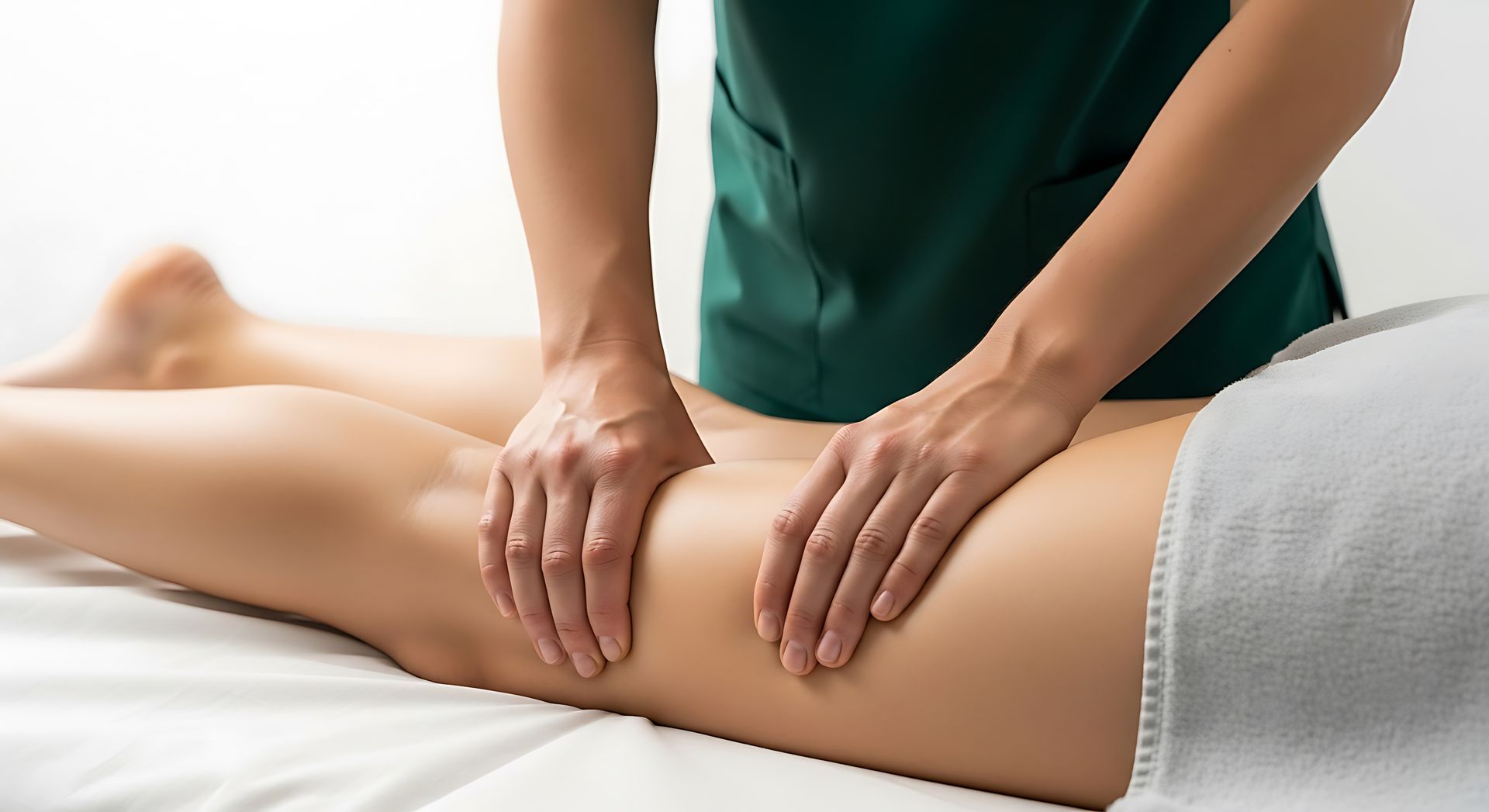
Traditional massage may involve kneading muscles, applying substantial pressure, manipulating deeper tissues or targeting areas of tension. Manual lymphatic drainage is typically characterized by lighter, rhythmic, carefully directed movements intended to encourage lymphatic fluid movement.
That light pressure surprises people.
Beauty culture often teaches us that stronger treatment equals stronger results. Deep pressure feels productive. Aggressive scraping looks dramatic on camera. A face turning pink after vigorous gua sha can make it seem as though something important is happening.
Lymphatic anatomy tells a different story.
Many of the initial lymphatic structures involved in fluid uptake are superficial. The objective of properly performed lymphatic techniques is therefore not to crush tissue as deeply as possible. In specialized therapeutic settings, movements are methodical and designed around lymphatic anatomy and drainage pathways.
That is very different from randomly rubbing a swollen area until it turns red.
The technique also matters particularly when someone has actual lymphatic impairment. A person who has undergone lymph-node removal, cancer treatment or surgery that altered normal drainage pathways may have needs that bear little resemblance to those of a healthy person booking a facial because they woke up puffy.
This is why the term "lymphatic drainage" now covers an unusually broad spectrum of services.
At one end is clinically oriented manual lymphatic drainage performed by trained professionals as part of lymphedema management or rehabilitation. At the other is a five-minute social-media facial routine performed at a bathroom mirror. Between those extremes are spa treatments, cosmetic facial massage, post-surgical recovery services, body-contouring massages and wellness rituals borrowing techniques and terminology from lymphatic therapy.
They should not automatically be treated as equivalent.
The Facial Lymphatic Drainage Obsession
Perhaps nowhere has lymphatic drainage become more visible than on the face.
It makes sense. Small changes in facial fluid distribution can be remarkably noticeable because the face contains so many contours that we unconsciously use to judge shape: the angle between the jaw and neck, the transition beneath the cheekbone, the under-eye region, the sides of the nose and the definition along the lower face.
When those transitions become softened by puffiness, the face can look heavier even though facial fat has not changed.
Reduce some of that swelling and suddenly the same facial anatomy looks more angular.
This is where terms such as "snatched," "sculpted," "lifted" and "defined" enter the conversation.
A lymphatic facial may indeed leave someone looking more sculpted. But describing that visual outcome accurately matters. A massage cannot reposition the facial skeleton. It does not perform the same function as surgical lifting. It does not permanently remove facial fat. It cannot create a new jawbone.
What it may do is reduce some superficial puffiness, which allows existing contours to become more visible.
That distinction doesn't diminish the result. In fact, it explains it.
Consider the under-eye region. A small amount of additional fluid around the eyes can make someone look tired or swollen. If that puffiness improves, the visual effect can be disproportionately large compared with the tiny amount of tissue volume involved. Similarly, reducing swelling around the lower face may make the border of the mandible—the jawbone—appear sharper.
This helps explain why before-and-after facial drainage videos can look so impressive without requiring the implausible conclusion that someone permanently changed their facial anatomy in fifteen minutes.
Sometimes the difference is simply that you are seeing more clearly what was already underneath.
Can Lymphatic Drainage Actually Change Facial Swelling?
There is biological plausibility for manipulating lymphatic fluid, but beauty marketing often races ahead of clinical evidence.
Research on manual lymphatic drainage has focused much more heavily on medical swelling and lymphedema than on healthy people trying to sharpen their cheekbones. Even within medical applications, results are nuanced rather than universally dramatic.
A systematic review examining MLD for lymphedema found mixed findings across studies. Some reported improvements in volume or symptoms, while others found no additional benefit when MLD was added to other components of treatment. A later meta-analysis examining breast-cancer-related lymphedema likewise found that some outcomes improved while changes in lymphedema volume were not statistically significant overall.
That doesn't mean lymphatic drainage "doesn't work." It demonstrates why broad claims require caution.
Studies examining postoperative facial swelling have also produced interesting but inconsistent findings. One small clinical trial after impacted wisdom-tooth removal reported reductions in several measures of swelling on the treated side. Another randomized trial involving patients after orthognathic jaw surgery observed faster decreases in swelling among those receiving MLD, but the differences did not reach statistical significance.
These are medical postoperative situations—not beauty facials in otherwise healthy people—but they help demonstrate an important principle: there are legitimate reasons researchers investigate MLD for edema, yet evidence does not justify treating every cosmetic promise as established fact.
For everyday facial puffiness, the most sensible expectation is therefore modest.
You may look less swollen.
You may look more defined.
You may prefer the way your face photographs afterward.
But that is different from saying that lymphatic massage permanently sculpts the face.
Why You Can Look Different After Just One Session
This may be the most fascinating part of the lymphatic-drainage phenomenon.
How can someone's body appear noticeably different after an hour if they haven't meaningfully lost fat?
Because appearance is influenced by more than fat.
Imagine a sculpted object underneath a thin layer of padding. Increase the thickness of that layer slightly and its edges look softer. Reduce the thickness and the contours become more obvious. Something similar can happen when fluid accumulation changes the way superficial tissues sit over underlying anatomy.
A reduction in swelling can create a more defined silhouette without removing fat.
This is especially noticeable in anatomical areas where small contour differences matter: beneath the chin, along the jaw, around the eyes, at the waist, across the lower abdomen and around joints.
Then there is another factor rarely discussed in viral before-and-afters: the treatment itself occurs in a controlled visual environment.
Someone may arrive after driving, sitting, eating, drinking or rushing to an appointment. They then lie down for an extended period, receive massage, relax, change clothing and are photographed again. Posture can change. Abdominal muscle engagement can change. Lighting can change. Camera distance can change. The angle of the pelvis can change. Even the way someone inhales or exhales can change how flat the abdomen looks.
That doesn't mean every transformation is staged.
It means photographs are not laboratory measurements.
A dramatic before-and-after should therefore prompt two separate questions:
Did this person's appearance change?
Possibly.
Does the photograph prove the mechanism claimed in the caption?
Not necessarily.
That distinction is essential across the entire aesthetics industry.
The Flat-Stomach Effect
One of the most viral applications of lymphatic drainage is body massage intended to create a flatter-looking abdomen and more defined waist.
Before-and-after images can be startling. The abdomen looks less distended. The waist seems narrower. The body appears almost "vacuumed" inward.
The temptation is to interpret this as fat loss.
Physiologically, that explanation makes little sense after a single massage.
Adipose tissue stores energy, and meaningful fat loss requires the body to mobilize stored energy over time. Massage does not simply squeeze fat cells until their contents disappear. If someone's waist looks different immediately after a lymphatic session, the change should not automatically be attributed to fat loss.
Fluid shifts offer a much more plausible explanation for at least part of the effect.
There may also be gastrointestinal variables. Abdominal appearance changes throughout the day depending on food intake, gas, stool, abdominal-wall position and bloating. Someone's abdomen can look dramatically different at 7 a.m. and 9 p.m. without any change in body fat.
Add fluid distribution, posture and muscle tone to that equation and the visual variability becomes even greater.
This is why "inches lost" immediately following a body treatment can be misleading when marketed as evidence of fat reduction. Circumference is influenced by more than adipose tissue. A short-term measurement change cannot automatically tell you what tissue changed.
The more scientifically honest description of a lymphatic body treatment is not necessarily less appealing: it may temporarily reduce the appearance of puffiness or fluid-related fullness in some people.
That's a very different promise from permanently reshaping the body.
Water Weight Is Not Body Fat
This distinction deserves more attention because the wellness industry frequently blurs it.
Your scale measures total body mass. It does not know whether a pound comes from fat, muscle, bone, food inside the gastrointestinal tract or water.
Fluid weight can fluctuate substantially over relatively short periods. This is why someone can step on a scale after a salty weekend, see a surprising increase and then watch much of it disappear over the following days. They did not necessarily gain and lose several pounds of adipose tissue at that speed.
Similarly, if a treatment changes fluid balance or if someone urinates more, sweats, fasts or changes carbohydrate and sodium intake, scale weight can fall without an equivalent loss of body fat.
Calling that weight loss is technically possible in the most literal sense—the scale may weigh less—but it creates the wrong impression if consumers interpret the phrase as fat loss.
Lymphatic drainage should therefore not be marketed as a replacement for nutrition, physical activity, evidence-based obesity treatment or body-contouring procedures designed to affect adipose tissue.
Its appeal lies somewhere else.
For someone who feels temporarily swollen or puffy, looking less swollen can be gratifying even when no fat has disappeared.
Not every beauty treatment needs to destroy fat to have cosmetic value.
Lymphatic Drainage vs. Deep-Tissue Massage
People booking their first lymphatic massage sometimes expect an intense experience.
They may assume the therapist will press deeply into the abdomen, vigorously knead the legs or use enough force to "push toxins out."
Proper lymphatic work is generally much gentler.
That difference makes more sense when you remember that the lymphatic network begins with delicate superficial structures. Deeper pressure is not automatically better. The goal is not to mechanically wring fluid out of the body like water from a towel.
Deep-tissue massage has different goals. It may focus on muscle tension, fascia, mobility, pain or other musculoskeletal concerns. Lymphatic techniques instead focus on fluid movement and lymphatic pathways.
A person can enjoy both types of massage, but they shouldn't assume the strongest pressure produces the strongest lymphatic effect.
This is especially relevant to aggressive social-media routines. If a facial massage leaves extensive bruising, significant pain or broken capillaries, calling the technique "lymphatic" does not automatically make that trauma beneficial.
Beauty culture sometimes equates sensation with efficacy.
Biology doesn't always cooperate with that philosophy.
What About Gua Sha?
The explosion of lymphatic beauty content has brought an ancient tool into a very modern beauty conversation: gua sha.
Facial gua sha tools are now sold everywhere from luxury beauty boutiques to drugstores. Videos demonstrate stones gliding along the jaw, cheekbones and neck, often accompanied by diagrams suggesting that fluid is being directed toward lymph nodes.
There are several separate concepts tangled together here.
First, gentle facial massage can temporarily influence the appearance of puffiness. Second, a smooth tool can provide a convenient surface for performing that massage. Third, people often find the ritual relaxing, which is a perfectly legitimate reason to enjoy it.
What becomes more difficult to substantiate are claims that the tool itself permanently lifts facial structures, fundamentally reshapes the face or "breaks up toxins."
A gua sha stone does not need mystical properties to be useful.
If it helps someone perform gentle massage comfortably and consistently, that can be enough.
The concern comes when consumers assume more pressure creates more drainage. Pressing extremely hard along the neck or repeatedly scraping delicate facial tissue is unnecessary for a basic depuffing routine and may simply irritate the skin.
The same principle applies to facial rollers, chilled globes and other sculpting tools. Some may enhance the experience. Cooling may temporarily reduce the perception of swelling. Massage may feel soothing. But a luxurious tool and an exaggerated biological claim are two different things.
The Difference Between Puffiness and Lymphedema
This distinction is critical.
A healthy person waking up with a slightly puffy face after a late dinner does not necessarily have a lymphatic disorder.
Lymphedema is a medical condition involving impaired lymphatic transport and chronic tissue swelling. It can occur because of congenital abnormalities of the lymphatic system or because lymphatic structures have been damaged later in life. Cancer treatment is one well-known cause: removal or injury of lymph nodes and lymphatic vessels during surgery or radiation can disrupt normal drainage.
Lymphedema can become chronic and can involve more than simply excess fluid. Over time, inflammatory and structural tissue changes can occur. Management may involve specialized approaches such as compression, exercise, skin care and components of complete decongestive therapy, sometimes including manual lymphatic drainage.
This is not interchangeable with a spa service advertised for "detox."
In fact, the evidence surrounding MLD in established lymphedema illustrates just how complicated lymphatic medicine is. A 2024 review of systematic reviews found support for complete decongestive therapy in breast-cancer-related lymphedema but noted variable quality in the evidence surrounding individual components and outcomes.
That should make us skeptical of anyone who claims that a single massage technique universally "fixes the lymphatic system."
Lymphatic disorders deserve actual assessment and appropriately trained care.
Why Movement Matters More Than Wellness Marketing Lets On
If lymphatic health is the goal, one of the least glamorous interventions may also be one of the most physiologically sensible:
move your body.
Lymph transport is influenced partly by the mechanical forces created when muscles contract and tissues move. Breathing-related pressure changes also contribute to fluid movement through the body. Collecting lymphatic vessels themselves have contractile activity, meaning the system isn't simply a passive network waiting for someone to massage it.
That makes walking particularly interesting.
Walking repeatedly contracts the muscles of the legs, changes tissue pressures and supports venous circulation while the body is upright. You don't need to rename walking "lymphatic walking" for those mechanical effects to exist.
The same applies to ordinary movement throughout the day.
Standing up after sitting for hours, taking a walk, moving your ankles during a long flight, exercising and breathing deeply all affect circulation and tissue mechanics in ways that interact with fluid movement.
This doesn't make professional lymphatic drainage unnecessary for everyone. It simply places massage within a much larger physiological picture.
The body isn't waiting for a beauty appointment before it can drain lymph.
The Post-Surgical Connection
One major reason lymphatic drainage has become so visible in beauty culture is its association with cosmetic surgery recovery.
After procedures such as liposuction, abdominoplasty and other operations, swelling is expected as part of the inflammatory and healing response. Some postoperative protocols incorporate lymphatic techniques, and specialized therapists may work with patients during recovery.
This is also where consumers need to be particularly careful.
A recently operated body is not the same as an otherwise healthy body receiving a relaxing spa massage.
Tissues may be inflamed, healing and vulnerable. Incisions may still be present. There may be bruising, altered sensation, fluid collections or surgical complications. The appropriate timing, technique and intensity can depend on the procedure, the surgeon's instructions and the patient's medical status.
Someone recovering from surgery should not assume that a viral lymphatic massage tutorial is appropriate simply because the influencer demonstrating it also had liposuction.
Research into postoperative MLD exists, including studies examining facial swelling after oral and maxillofacial surgery, but findings are not uniform and protocols vary.
Postoperative massage should therefore be viewed as part of recovery care—not as a challenge to see how aggressively fluid can be pushed around freshly operated tissues.
That postoperative context becomes especially important as the conversation moves from visible depuffing into the larger claims surrounding body sculpting, recovery and wellness.
So Why Does Lymphatic Drainage Feel So Good?
Not every benefit of a beauty or wellness treatment has to be measured in centimeters.
Lymphatic massage is typically slow, rhythmic and gentle. Many people find that profoundly relaxing.
A session may create an hour in which someone is lying still, breathing more slowly, disconnecting from a phone and receiving repetitive, soothing touch. Even if every dramatic claim attached to the treatment were removed, relaxation itself could remain meaningful.
This matters because wellness marketing often feels obligated to convert every pleasurable experience into a medical intervention.
A massage can't simply feel wonderful—it must "release toxins."
A facial can't simply reduce temporary puffiness—it must "detox the lymph."
A relaxing ritual can't simply help someone unwind—it must "reset the nervous system."
Sometimes the more accurate explanation is also the simpler one.
A gentle massage can feel good.
A less puffy face can make you feel more confident.
A relaxing hour can be worth paying for.
Those experiences do not become less valuable simply because we refuse to attach unsupported biological claims to them.
Temporary Doesn't Mean Fake
Perhaps the biggest misconception surrounding lymphatic drainage comes from the word temporary.
Beauty consumers are often taught to interpret temporary results as worthless. If an effect doesn't last forever, it must have been fake.
But most beauty is temporary.
A blowout doesn't permanently change the structure of your hair. Makeup washes off. A facial can leave skin looking luminous without permanently transforming it. Botox gradually wears off. Dermal filler is not necessarily permanent. Even surgical aging outcomes continue to exist within a body that keeps aging.
Duration and legitimacy are separate questions.
If lymphatic drainage reduces visible puffiness for a period of time, the fact that fluid can accumulate again doesn't mean the initial change never happened.
It simply tells us what kind of treatment we're dealing with.
This is also why lymphatic drainage may make sense before a photograph, wedding, event or other occasion for someone who personally notices a depuffing effect. The goal in that situation isn't permanent anatomical reconstruction. It is looking refreshed for a particular moment.
Problems arise when a temporary fluid-related change is marketed as permanent body contouring.
That transforms a reasonable cosmetic expectation into an exaggerated one.
The Before-and-After Problem
Few things sell beauty treatments as effectively as side-by-side photographs.
Lymphatic drainage is almost perfectly designed for this marketing format because even relatively small changes in puffiness can photograph dramatically.
But before-and-after images should always be interpreted carefully.
Lighting matters. Camera height matters. Lens distance matters. Posture matters. Clothing placement matters. Muscle contraction matters. Hydration matters. The time of day matters.
For abdominal photographs in particular, pelvic positioning and abdominal engagement can completely change the silhouette. Someone can produce two surprisingly different photographs seconds apart simply by adjusting posture and breathing.
A trustworthy provider should not need to manipulate those variables to demonstrate results.
Ideally, before-and-after photography should be standardized: same lighting, same camera, same distance, same body position and comparable conditions.
Even then, a photograph tells us what someone looked like, not necessarily why they looked that way.
If the waist appears smaller, that doesn't identify whether the difference came from tissue fluid, posture, bloating or another variable.
This is why scientific studies use objective measurements rather than relying solely on Instagram photographs.
The photograph can start the conversation.
It shouldn't automatically end it.
Where Beauty Meets Biology
Lymphatic drainage occupies a fascinating position in modern wellness because neither extreme captures the full story.
Calling the entire practice pseudoscience ignores a genuine anatomical system and a therapeutic technique with established roles in lymphatic care.
Calling it a universal detoxification treatment capable of melting fat, eliminating cellulite and flushing unnamed toxins from the body goes much further than available evidence supports.
The interesting truth sits between those poles.
Your lymphatic system really does transport fluid.
Changes in tissue fluid really can change how you look.
Manual techniques may influence swelling in certain circumstances.
Reducing puffiness really can reveal more facial or body definition.
And none of those statements requires us to pretend that a massage destroyed fat cells.
That may ultimately be the most useful way to think about lymphatic beauty: not as a shortcut to a different body, but as one way of temporarily influencing the fluid that sits within the body you already have.
And once you understand that distinction, many of the dramatic transformations circulating online suddenly make much more sense.
A sharper jawline doesn't necessarily mean facial fat disappeared.
A flatter stomach doesn't necessarily mean abdominal fat disappeared.
A lower number on the scale doesn't necessarily mean adipose tissue disappeared.
Sometimes what changed was simply fluid.
And sometimes that is enough to create a surprisingly visible result.
When the Claims Get Bigger
The second half of the lymphatic-drainage story is where things become even more interesting, because once this legitimate physiological process entered the wellness world, the promises expanded quickly.
Can lymphatic drainage actually detox your body, or are your liver and kidneys doing something entirely different? Can it reduce cellulite—or does it only temporarily change how cellulite appears? Can it cause weight loss? Is dry brushing doing anything to lymph? Does drinking more water "flush" the lymphatic system? Can you safely perform drainage on yourself every day? What about gua sha, facial rollers and at-home body tools?
Then there is the rapidly expanding world of post-surgical lymphatic drainage. When can it be helpful? When can massage after liposuction be inappropriate? What qualifications should you look for in a practitioner? And which medical conditions make lymphatic massage something you should discuss with a healthcare professional rather than casually booking at a spa?
The next step is to separate the genuinely interesting science from some of the biggest claims surrounding the lymphatic beauty boom.
Because lymphatic drainage doesn't need to "melt fat" or magically cleanse the body to be worth understanding.
The real biology is interesting enough.
Detox, Cellulite, Body Sculpting & What the Science Actually Says
The story begins with why lymphatic drainage can sometimes produce a surprisingly visible before-and-after. From there, the conversation moves to where social media tends to take over.
Because reducing puffiness apparently wasn't exciting enough.
Somewhere between the treatment room and the internet, lymphatic drainage acquired an extraordinary list of supposed abilities. It became a "detox." Then a metabolism booster. Then a weight-loss treatment. It was promoted as a way to eliminate cellulite, flatten the stomach, sharpen the jawline, improve digestion, strengthen immunity, remove inflammation and cleanse the body of substances it supposedly could not eliminate on its own.
The problem is that several very different biological processes have been compressed into one extremely marketable word:
drainage.
The lymphatic system really does drain excess fluid from tissues. It really does transport substances through the body. Lymph nodes really do participate in immune surveillance. And impaired lymphatic function really can cause serious swelling.
But none of those facts automatically proves that a healthy person's lymphatic system needs to be "detoxed" by a massage.
That distinction matters because lymphatic drainage may have legitimate cosmetic and therapeutic applications without being capable of everything attributed to it. In fact, one of the most useful ways to understand this treatment is to stop asking whether lymphatic drainage "works" and start asking a much more specific question:
Works for what?
Reducing certain types of swelling is different from losing fat. Temporarily changing the appearance of cellulite is different from permanently restructuring cellulite. Supporting someone with diagnosed lymphedema is different from "cleansing" a healthy body. Postoperative care is different from a spa massage before vacation.
Once those differences are separated, the lymphatic beauty boom becomes much easier to understand.
The Great "Detox" Question
Few words have been more successful in modern wellness marketing than detox.
Detox teas promise it. Juice cleanses promise it. Supplements promise it. Sauna routines promise it. Body wraps promise it. Dry brushing promises it. And lymphatic massage may be one of the most convincing versions because the lymphatic system genuinely does transport waste products and cellular material away from tissues.
The leap happens when that physiological fact is transformed into the idea that ordinary healthy people are accumulating mysterious "toxins" that need to be manually pushed out of their bodies.
That isn't how human detoxification works.
Your body already has sophisticated systems for processing and eliminating substances. The liver chemically processes many compounds and plays an enormous role in metabolism and detoxification. The kidneys continuously filter the blood, regulating water and electrolytes while eliminating many waste products into urine. The gastrointestinal tract removes other material through feces, while the lungs eliminate carbon dioxide and certain volatile compounds.
The lymphatic system participates in this larger physiological network, but it isn't a bag of dirty water waiting to be squeezed clean.
Lymphatic vessels collect excess interstitial fluid and transport it through lymph nodes before lymph ultimately returns to the venous circulation. Once material is back within the circulation, other organs continue the processes required to metabolize or eliminate it.
That means saying lymphatic massage "removes toxins" without identifying which toxin, how much is being removed, where it goes and whether the treatment measurably changes its elimination is scientifically vague.
UCLA Health addressed precisely this distinction in 2026, noting that claims about detoxification, immune enhancement and weight loss in otherwise healthy people have outpaced substantial scientific evidence.
This doesn't make the lymphatic system unimportant.
It makes it important enough to describe accurately.
What Happens to the Fluid After a Lymphatic Massage?
This is one of the questions that wellness explanations frequently skip.
If lymphatic drainage "moves fluid," where exactly is that fluid going?
Lymph collected from tissues moves through increasingly larger lymphatic vessels and eventually returns to the bloodstream through major lymphatic ducts that empty into the venous circulation near the neck and upper chest. From there, the fluid is once again part of the circulating blood volume.
Your kidneys can then regulate fluid and electrolyte balance as part of their normal function.
This helps explain why lymphatic drainage should not be imagined as literally pushing liquid through the skin or squeezing waste directly out of the body.
Nothing magical needs to happen.
The treatment is interacting with fluid transport pathways that already exist.
And for most people with functioning lymphatic systems, those pathways are operating whether or not a massage is scheduled.
Does Lymphatic Drainage Make You Pee More?
This claim is extremely common after lymphatic treatments.
Some people report needing to urinate more frequently after a session. That experience is possible, but it shouldn't be treated as proof that "toxins are leaving the body."
Urine production is influenced by fluid intake, hormones, blood volume, kidney function, medications, caffeine, alcohol, sodium balance and numerous other factors. If fluid distribution changes, or if someone drinks substantially more water around the time of a treatment, urine output can change as well.
But seeing more urine in the toilet does not tell you that a specific toxin was removed.
It tells you that your kidneys produced urine.
That may sound obvious, but it illustrates how easily normal physiology becomes rebranded as evidence for a wellness claim.
Can Lymphatic Drainage Help You Lose Weight?
This may be one of the biggest misunderstandings surrounding the treatment.
Lymphatic drainage is not a fat-loss treatment.
Adipose tissue represents stored energy. Reducing meaningful amounts of body fat requires the body to mobilize stored triglycerides and use that energy over time. Massage does not cause fat cells throughout the abdomen or thighs to simply empty because someone pushed lymph toward a lymph node.
If the scale decreases after a lymphatic session, the most plausible short-term explanation is a change involving fluid, gastrointestinal contents or other normal fluctuations in body mass—not meaningful destruction of adipose tissue.
This distinction becomes particularly important when before-and-after measurements are used in advertising.
Imagine someone has a waist circumference measured immediately before a treatment and again afterward. The second measurement is smaller.
That does not automatically mean fat was lost.
Circumference can be influenced by fluid distribution, bloating, breathing, posture, abdominal-muscle engagement, tape placement and even how tightly the measuring tape is pulled.
The same applies to the scale.
Losing two pounds of water is not physiologically equivalent to losing two pounds of fat.
Both may produce a lower number on a scale, but the mechanisms—and long-term implications—are entirely different.
UCLA Health similarly notes that there isn't substantial evidence supporting weight-loss claims from lymphatic drainage in people with healthy lymphatic systems.
A person may still feel lighter, less swollen or more comfortable after treatment.
That experience doesn't require us to call it fat loss.
Can Lymphatic Drainage Flatten Your Stomach?
Here the answer becomes more interesting.
It may make some people's stomachs temporarily look flatter.
That is not the same as reducing abdominal fat.
Abdominal appearance is extraordinarily variable. What you see in the mirror is influenced by subcutaneous fat, visceral structures, food and fluid inside the gastrointestinal tract, intestinal gas, stool, posture, pelvic position, abdominal-muscle tension and tissue fluid.
This is why your abdomen can look relatively flat in the morning and noticeably fuller after dinner without you gaining any meaningful amount of body fat between breakfast and bedtime.
Someone experiencing fluid-related puffiness may notice a visible improvement after massage. A person who has been lying comfortably for an hour may also stand differently afterward. Relaxation, posture and breathing can alter abdominal appearance.
That means the famous "lymphatic stomach transformation" doesn't necessarily have to be fake.
The mistake is assuming that the photograph proves fat loss.
Sometimes the body can look significantly different without its fat mass changing at all.
Cellulite: Where Lymphatic Drainage Gets Even More Complicated
Cellulite may be one of the most misunderstood cosmetic concerns in existence.
It is also extremely common.
The dimpled or uneven appearance typically seen on the thighs, buttocks and sometimes abdomen is related to the architecture of skin, subcutaneous fat and fibrous connective-tissue septae. Those structures interact in ways that allow portions of fat to protrude while connective bands tether other areas downward, contributing to the familiar dimpled surface.
Cellulite is not simply "toxins trapped beneath the skin."
It is not proof of poor health.
It isn't caused solely by excess body fat, either. People across a wide range of body sizes can have cellulite because anatomy, connective tissue, genetics, hormones, skin thickness and other factors contribute to its appearance.
So where does lymphatic drainage fit?
If fluid accumulation contributes to tissue fullness, reducing that fluid could theoretically make the skin surface appear somewhat smoother in certain people. Massage can also temporarily alter circulation and tissue appearance.
But temporarily improving how cellulite looks is not the same thing as permanently altering the anatomical structures responsible for cellulite.
A lymphatic massage cannot simply wash fibrous septae away.
This distinction is similar to what happens with facial drainage: reducing puffiness can reveal underlying contours without fundamentally rebuilding the anatomy beneath them.
If cellulite appears smoother after a massage, enjoy the result.
Just understand what probably did—and didn't—change.
Why "Cellulite Removal" Is Such a Difficult Promise
There is another reason consumers should be cautious about dramatic cellulite claims: cellulite itself changes depending on body position.
Stand normally and you may see dimpling.
Contract the gluteal muscles and the pattern may change.
Sit down and the tissue redistributes.
Change the lighting from soft frontal light to harsh overhead light and cellulite can suddenly appear dramatically more prominent.
That makes cellulite before-and-after photography especially vulnerable to manipulation.
A provider doesn't necessarily need Photoshop to produce an impressive transformation. Changing lighting, posture, muscle contraction or camera angle can be enough.
For consumers evaluating lymphatic treatments—or any cellulite treatment—the better question is not simply, "Does the after photo look smoother?"
It is:
Was the photograph taken under standardized conditions, and how long did the result last?
A fifteen-minute improvement and a six-month structural improvement are very different outcomes.
What About Dry Brushing?
Dry brushing may be the perfect example of a beauty ritual acquiring a medical-sounding explanation.
The practice usually involves moving a firm-bristled brush across dry skin, often in strokes directed toward the torso. Advocates frequently say this "stimulates lymphatic drainage," eliminates toxins and reduces cellulite.
There are several things dry brushing can clearly do.
It can exfoliate the skin.
It can temporarily increase superficial redness because friction affects the skin and local circulation.
It can feel invigorating.
And some people simply enjoy the ritual.
What is far less established is the idea that dry brushing meaningfully detoxifies a healthy person's body or produces lasting cellulite reduction.
There is also a practical contradiction worth noticing: authentic manual lymphatic techniques are generally described as gentle, yet some dry-brushing routines encourage vigorous pressure.
More friction does not necessarily mean more lymphatic drainage.
If someone enjoys dry brushing and their skin tolerates it, there is nothing inherently wrong with enjoying the cosmetic exfoliation and sensory ritual.
But you do not need to believe that a brush is pulling toxins from your tissues to justify using it.
Gua Sha, Rollers and the Five-Minute Morning "Face Detox"
Facial lymphatic routines have become their own category of beauty content.
Someone wakes up puffy, applies facial oil and spends several minutes moving a gua sha tool or roller across the skin. By the end, the face appears slightly more defined.
This is one of the areas where realistic expectations can make a trendy ritual perfectly reasonable.
Gentle facial massage may help some people temporarily reduce the appearance of puffiness. Cooling tools can also temporarily affect the appearance and sensation of swollen tissue. And the repetitive ritual may simply feel relaxing.
The mistake is turning a reasonable depuffing technique into a claim that a five-minute routine permanently lifts the face.
A gua sha tool cannot reproduce a facelift.
A roller cannot permanently reposition facial fat compartments.
A massage cannot build a new jawbone.
But a face with less superficial puffiness can certainly look more sculpted.
That difference is worth preserving because it allows consumers to appreciate what a treatment can do without expecting something biologically impossible.
How Gentle Is "Gentle"?
One of the most important concepts in lymphatic massage is that aggressive pressure is not automatically more effective.
Cleveland Clinic describes lymphatic drainage as a gentle form of massage intended to move excess fluid toward functioning lymph vessels and nodes.
This is particularly relevant to at-home facial massage.
People sometimes scrape aggressively along the jaw because they believe they are physically forcing fluid—or even fat—out of the face.
If a facial drainage routine hurts, leaves significant bruising or repeatedly irritates the skin, stronger pressure is not necessarily producing better lymphatic results.
The lymphatic structures involved in superficial fluid collection are close enough to the skin that lymphatic techniques don't need to resemble deep-tissue massage.
The goal is not to squeeze the face empty.
Can You Do Lymphatic Drainage at Home?
For an otherwise healthy person who simply wants a gentle facial or body massage, self-massage may be an accessible part of a wellness routine.
But there is an important difference between recreational depuffing and treating a medical lymphatic condition.
Someone with diagnosed lymphedema should not simply copy a random influencer's technique. Their normal drainage pathways may have been altered by surgery, radiation or disease, which can affect where fluid should be directed.
Cleveland Clinic recommends that people with lymphedema discuss self-massage with their healthcare provider and learn appropriate techniques rather than improvising treatment.
For healthy users, the guiding principle should be gentle rather than aggressive.
Facial massage doesn't need to leave the skin raw.
Body massage doesn't need to hurt.
And bruising should not be interpreted as evidence that toxins have been released.
Does Drinking Water "Flush the Lymph"?
Hydration is another area where reasonable health advice becomes exaggerated.
Your body needs adequate water. Dehydration affects many physiological processes. Drinking enough fluid is obviously important for normal health.
But the phrase "flush your lymphatic system" creates an image of pouring water through dirty plumbing.
Human physiology isn't that simple.
If someone is dehydrated, restoring adequate hydration is beneficial. But forcing enormous quantities of water into an already well-hydrated body does not necessarily produce superior lymphatic function.
Your kidneys carefully regulate water balance, and drinking excessive amounts of water can itself become dangerous in extreme circumstances because it can disturb electrolyte concentrations.
The sensible advice is less dramatic:
Stay appropriately hydrated.
You do not need to drown yourself in water to make your lymphatic system work.
The Role of Exercise
If someone wants to support normal fluid movement, ordinary physical activity deserves far more attention than most viral "lymph hacks."
Unlike the cardiovascular system, the lymphatic system doesn't have a single central pump equivalent to the heart. Movement of lymph is supported by several mechanisms, including contractions within collecting lymphatic vessels as well as external mechanical forces created by skeletal-muscle activity, movement and changes in pressure during breathing.
This means walking is already doing something relevant.
So is moving your ankles.
So is changing positions after sitting for hours.
So is exercise.
So is breathing.
The human body was built to move, and normal movement interacts with circulatory and lymphatic physiology throughout the day.
You don't necessarily need a special "lymphatic workout."
Sometimes the wellness trend is simply normal movement with better branding.
What About Rebounding?
Mini-trampolines—or rebounders—have become another popular recommendation for "activating" lymphatic flow.
Jumping certainly creates muscle contractions and mechanical movement, so there is physiological logic behind the idea that movement can contribute to lymph transport.
But that doesn't mean rebounding possesses a unique detoxifying power unavailable through other forms of movement.
Walking, dancing, cycling, resistance training and other physical activities also create muscular contractions and tissue movement.
If you enjoy rebounding, it can be a fun form of activity.
You don't need to believe it is shaking toxins out of your lymph nodes for it to be worthwhile.
The Post-Liposuction Lymphatic Massage Boom
This is where lymphatic drainage moves from casual beauty ritual into a much more medically relevant territory.
After liposuction, tissues undergo trauma. Cannulas have moved through subcutaneous tissue, fat has been removed, inflammatory processes begin and postoperative swelling is expected.
The body you see during early recovery is not the final surgical result.
Swelling can temporarily obscure contour, and postoperative tissue changes can evolve for weeks or months.
Because of this, lymphatic drainage has become extremely popular after liposuction, abdominoplasty and other body-contouring surgeries.
There is some evidence supporting its use within certain postoperative protocols, but the literature has important limitations.
A prospective clinical study involving 18 women after liposuction or lipoabdominoplasty reported reductions in pain, swelling and tissue fibrosis following a program combining manual lymphatic drainage with therapeutic ultrasound. However, because the treatments were combined and the study was small, it cannot tell us how much of the result came specifically from MLD.
Another prospective comparative study involving 20 women after abdominoplasty with core liposuction investigated whether MLD could accelerate resolution of postoperative edema, illustrating the ongoing clinical interest in this area.
The takeaway isn't that postoperative lymphatic drainage is useless.
It's that postoperative care should be individualized rather than dictated by social-media trends.
After Surgery, Your Surgeon Comes First
This deserves emphasis.
If you have undergone liposuction, a tummy tuck, facelift or another procedure, do not book aggressive postoperative massage simply because a social-media creator says everyone needs it immediately.
Your surgeon knows what procedure was performed.
They know where incisions are located.
They know how tissues were manipulated.
They know whether drains were placed.
They know your medical history and whether any complication is suspected.
Postoperative swelling can be normal—but swelling can also occur alongside complications that require medical evaluation.
A massage therapist should never become a substitute for your surgeon when something appears wrong.
Increasing pain, fever, redness, drainage, shortness of breath, rapidly worsening swelling or other concerning symptoms deserve appropriate medical attention rather than an assumption that you merely need to "drain harder."
Postoperative Massage Shouldn't Be Torture
Social media has also popularized extremely aggressive postoperative body massage.
Videos sometimes show recently operated patients grimacing while practitioners push forcefully across swollen tissue.
Pain is then framed as proof that the treatment is "breaking up fibrosis."
That should raise questions.
Postoperative tissues are healing tissues.
There may be circumstances where specialized therapists use techniques for fibrosis or tissue mobility later in recovery, but a recently operated body should not automatically be subjected to maximal pressure.
Technique, timing and intensity matter.
A qualified postoperative professional should understand surgical recovery and recognize when something is outside their scope.
The goal is not to see how much pain someone can tolerate.
What About Fibrosis After Liposuction?
Post-liposuction firmness and contour irregularities are often described online using the broad term fibrosis.
Healing after tissue trauma involves inflammation, collagen deposition and remodeling. Some people develop areas of firmness or irregularity during recovery, and these may evolve as healing progresses.
This is another area where massage, compression and rehabilitation strategies may be incorporated into postoperative protocols.
The 2014 clinical study combining therapeutic ultrasound with manual lymphatic drainage reported reductions in measured fibrosis along with swelling and pain. But again, because the study combined interventions and involved only 18 participants, it should be viewed as suggestive rather than definitive proof of a universal protocol.
More recent postoperative research continues to examine multimodal rehabilitation rather than treating lymphatic massage as an isolated miracle treatment.
That nuance is important.
Surgical recovery is complex.
No single massage technique controls every part of healing.
Lymphatic Drainage After a Facelift
Facial surgery creates another situation where swelling can be substantial.
After procedures involving the face and neck, swelling can temporarily obscure the new contour. Patients may understandably want that swelling gone as quickly as possible.
But freshly operated facial tissues require caution.
Massage should only begin when the treating surgeon considers it appropriate, and technique may depend on what was actually done during surgery.
A deep-plane facelift, neck lift, liposuction and other facial procedures involve different tissues and surgical planes.
Someone else's postoperative TikTok routine is therefore not a personalized recovery plan.
This is a recurring theme in modern aesthetics:
The more invasive the procedure, the less appropriate generic internet instructions become.
Lymphatic Drainage and Lymphedema Are Not the Same Conversation
Beauty culture has borrowed heavily from a therapy developed for people with genuine lymphatic dysfunction.
That history deserves respect.
Lymphedema can occur when lymphatic vessels or nodes are damaged or insufficient, causing chronic swelling and potentially other tissue changes. Breast-cancer treatment is one important cause of secondary lymphedema because surgery and radiation can affect lymphatic pathways.
Management may include complete decongestive therapy, which can incorporate compression, exercise, skin care and manual lymphatic drainage.
But even here—the area where MLD has one of its strongest clinical rationales—the evidence is more nuanced than wellness marketing often suggests.
A systematic review of 17 studies involving 869 participants found conflicting results. Some studies reported benefits involving limb volume, symptoms or quality of life, while others found no additional benefit when MLD was added to complex decongestive therapy. The authors concluded that methodological limitations and conflicting findings meant additional research was needed.
A later review of systematic reviews examining complete decongestive therapy for breast-cancer-related lymphedema likewise emphasizes the broader treatment package rather than presenting massage alone as a cure.
This is important context.
If the scientific conversation remains nuanced even when treating actual lymphatic disease, consumers should be skeptical when an influencer promises that five minutes of massage will "detox your entire body."
Who Should Be Careful With Lymphatic Drainage?
Because lymphatic massage is gentle and noninvasive, it can seem universally harmless.
It isn't appropriate for everyone.
Cleveland Clinic advises against lymphatic drainage in several situations, including certain cases involving blood clots or deep-vein thrombosis, cellulitis and other infections, heart disease, kidney disease, cancerous tissue and some other medical circumstances.
Why?
Because moving fluid isn't always desirable when the body is struggling to manage that fluid or when a dangerous underlying condition may be present.
Someone with significant heart failure, for example, may have difficulty managing circulating volume. Someone with kidney disease may have impaired fluid regulation. A suspected blood clot is not something that should be massaged in an attempt to reduce swelling.
And an infection causing redness, warmth and swelling isn't simply "stagnant lymph."
These are situations in which medical evaluation matters more than beauty treatment.
Swelling Isn't Always a Beauty Problem
This may be one of the most important lessons in the entire lymphatic conversation.
People increasingly diagnose themselves with "poor lymphatic drainage" whenever they notice swelling.
But swelling has many potential causes.
Some are harmless and temporary.
Others aren't.
Persistent or unexplained swelling can be associated with venous problems, medications, infection, injury, kidney disease, heart disease, liver disease, hormonal changes and true lymphatic dysfunction, among other causes.
One-sided leg swelling is particularly different from waking up with a mildly puffy face after eating salty food.
A massage appointment should not replace medical assessment when swelling is new, significant, painful, asymmetric, rapidly worsening or otherwise concerning.
Beauty language can sometimes make symptoms sound benign.
"You're just holding toxins" is reassuring.
It can also be wrong.
Can Lymphatic Massage Boost Your Immune System?
This claim sounds plausible because the lymphatic system is deeply involved in immune function.
Lymph nodes contain immune cells. Lymph transports immune cells and biological material. The lymphatic and immune systems are intimately connected.
But once again, physiological involvement doesn't automatically prove a therapeutic claim.
The fact that lymph nodes participate in immunity does not establish that massage meaningfully "boosts" immunity in a healthy person.
The phrase boost your immune system is itself frustratingly vague.
Boost which cells?
By how much?
For how long?
Against which infection?
And does the change actually improve a meaningful health outcome?
Without answers to those questions, "immune boosting" functions more as marketing language than a precise medical claim.
UCLA Health similarly identifies immunity enhancement among popular lymphatic-drainage claims that lack substantial evidence in healthy people.
Your immune system is extraordinarily sophisticated.
It does not simply have an ON switch hidden underneath your collarbone.
Is Lymphatic Drainage Anti-Inflammatory?
This claim requires even more nuance.
Inflammation is not one thing.
Acute inflammation after an injury is different from chronic inflammatory disease. Postoperative inflammation is different from an autoimmune disorder. Local swelling is different from systemic inflammatory signaling.
Because lymphatic vessels participate in fluid balance and immune-cell trafficking, lymphatic biology is intimately connected with inflammation.
But saying "the lymphatic system interacts with inflammation" is not the same as saying "lymphatic massage treats inflammation" in every context.
If someone's visible puffiness decreases, they may describe themselves as looking "less inflamed."
Cosmetically, that phrase may make intuitive sense.
Medically, however, reduced swelling and reduced systemic inflammation are not necessarily the same outcome.
Precision matters.
The Wellness Industry's Favorite Mistake: Turning Biology Into a Promise
This pattern isn't unique to lymphatic drainage.
Beauty and wellness marketing often starts with a true biological statement.
Collagen supports skin structure.
True.
Therefore, every collagen-related product rebuilds your skin?
Not necessarily.
The lymphatic system transports fluid and participates in immune function.
True.
Therefore, massage detoxifies the body, causes weight loss and boosts immunity?
Not necessarily.
Circulation delivers oxygen and nutrients to tissues.
True.
Therefore, anything that temporarily increases skin redness permanently rejuvenates the tissue?
Again, not necessarily.
The distance between a true physiological fact and a proven clinical outcome can be enormous.
Understanding that gap may be one of the most useful skills a beauty consumer can develop.
How to Choose a Lymphatic Drainage Provider
The right provider depends heavily on why you want the treatment.
If you're a healthy person seeking a relaxing facial and temporary depuffing, a reputable licensed professional experienced in gentle facial massage may be perfectly appropriate.
If you have diagnosed lymphedema, a history of lymph-node removal or a complex medical condition, the qualifications become much more important. You may need a clinician or therapist specifically trained in lymphedema management.
If you're recovering from surgery, your surgeon's recommendations should guide the process.
Ask providers what training they have.
Ask what technique they use.
Ask whether they regularly work with clients in your situation.
Ask what they believe the treatment can realistically accomplish.
And pay attention to the language they use.
A provider who explains that results may involve temporary changes in swelling is giving you a very different message from someone promising to "melt ten pounds of toxic fat."
The more extraordinary the claim, the more evidence it should require.
What Should a Professional Session Feel Like?
For conventional manual lymphatic drainage, gentle is the recurring word.
The movements may feel rhythmic and light rather than deep and muscular. Someone accustomed to deep-tissue massage may even wonder whether enough pressure is being used.
That does not mean nothing is happening.
MLD is intended to work with lymphatic anatomy rather than overpower tissue with force.
A relaxation-focused wellness session may also include breathing exercises, gentle abdominal work and methodical movements across different areas of the body.
The exact protocol depends on the practitioner's training and the reason for treatment.
A post-surgical session may differ considerably from a facial.
A lymphedema treatment differs again.
The phrase "lymphatic drainage" alone does not tell you exactly what service you're receiving.
Ask.
How Often Do You Need Lymphatic Drainage?
For healthy people seeking cosmetic depuffing, there is no universal scientifically established schedule saying everyone needs weekly—or monthly—lymphatic massage.
Frequency depends on the goal.
Someone may book a treatment occasionally because they enjoy it.
Someone preparing for an event may schedule a facial because they personally notice less puffiness afterward.
Someone with lymphedema may follow a structured treatment plan prescribed by their healthcare team.
Someone recovering from surgery may have a surgeon-directed schedule.
These scenarios should not be collapsed into one recommendation.
If a spa tells every customer that their body will become "toxic" unless they return every week, skepticism is warranted.
Your lymphatic system is not a subscription service.
The "Maintenance" Question
One of the most revealing questions to ask after any aesthetic treatment is:
What exactly am I maintaining?
If lymphatic drainage temporarily reduces puffiness, recurring treatments may reproduce that cosmetic effect.
That is reasonable.
But if someone claims repeated massage permanently reprograms a healthy lymphatic system, eliminates fat or prevents toxins from accumulating, ask what evidence supports that claim.
Maintenance makes sense when the underlying result itself is temporary.
It becomes questionable when temporary effects are being marketed as evidence of permanent physiological transformation.
When Is the Best Time to Get Lymphatic Drainage?
For cosmetic purposes, timing is largely personal.
Some people notice that they are puffier after travel, high-sodium meals, alcohol consumption, poor sleep or certain phases of their menstrual cycle. Others simply enjoy treatment before an event.
If someone consistently sees a temporary depuffing effect, scheduling a treatment before a wedding, photoshoot or special occasion may be more logical than expecting permanent facial restructuring.
However, first-time treatments immediately before a major event always carry some uncertainty. Even gentle treatments can occasionally leave someone feeling different than expected, and facial products used during a service can irritate sensitive skin.
Testing a treatment before the week of an important event is usually more sensible than experimenting the night before.
What Lymphatic Drainage Can Realistically Do
After cutting through the extraordinary claims, the realistic version of lymphatic drainage is actually still appealing.
It may help manage certain types of swelling.
It has a legitimate role within some lymphedema treatment programs.
It may be incorporated into appropriately supervised postoperative recovery.
Healthy people may notice temporary reductions in puffiness.
Facial contours can appear more defined when swelling decreases.
A body that feels fluid-heavy may temporarily feel more comfortable.
The treatment can be deeply relaxing.
Those aren't insignificant benefits.
They simply aren't the same as detoxification, fat destruction or permanent body sculpting.
What Lymphatic Drainage Probably Isn't Doing
It isn't vacuuming toxins out of your body.
It isn't replacing your liver.
It isn't replacing your kidneys.
It isn't permanently melting abdominal fat.
It isn't permanently erasing cellulite.
It isn't reconstructing your facial skeleton.
It isn't a substitute for evidence-based weight management.
And it isn't a treatment for every unexplained episode of swelling.
The beauty industry often fears that realistic expectations will make a treatment sound less exciting.
But credibility can be more valuable than hype.
There is something refreshing about a service that can simply say:
You may feel less puffy. You may look a little more defined. You may feel relaxed. And you may really enjoy it.
For many people, that's enough.
So, Is the Lymphatic Beauty Boom Worth the Hype?
Partially.
The internet didn't invent the lymphatic system, and manual lymphatic drainage isn't a fake treatment created by influencers. It has a real history in the management of lymphatic disorders, and lymphatic physiology absolutely influences tissue fluid and swelling.
What social media did was take those facts and build a much larger mythology around them.
Some of the before-and-after transformations are physiologically plausible.
A reduction in fluid-related puffiness can change someone's appearance.
A less swollen face can reveal a sharper jawline.
A less fluid-heavy body can appear slightly more defined.
Postoperative swelling may respond to appropriately selected therapeutic approaches.
But those realities do not establish that lymphatic massage detoxifies healthy people, burns fat, permanently eliminates cellulite or universally boosts immunity.
The most accurate conclusion is therefore neither dismissive nor evangelical.
Lymphatic drainage is a legitimate technique whose benefits depend heavily on who is receiving it, why they are receiving it and what outcome they expect.
That last part may matter most.
If you book lymphatic drainage expecting your kidneys to resign because your massage therapist has taken over detoxification duties, you're asking the treatment to do something it was never designed to do.
If you expect permanent fat loss, disappointment is likely.
If you expect a noninvasive facelift, the anatomy doesn't support the promise.
But if you understand that temporary changes in tissue fluid can influence the way the face and body look—and you enjoy the treatment—the experience makes much more sense.
The Aledore Takeaway
The lymphatic beauty boom represents something bigger than one trending massage.
It shows how easily legitimate medical terminology can migrate into beauty culture.
A therapeutic technique becomes a facial.
A facial becomes a sculpting treatment.
Sculpting becomes detoxification.
Detoxification becomes weight loss.
And eventually, a five-minute gua sha video promises to accomplish things that would require entirely different biological mechanisms.
The solution isn't to reject every wellness treatment that lacks permanent results.
It's to become better at distinguishing aesthetic effect from biological claim.
A treatment can make you look better without rebuilding your anatomy.
It can make you feel better without curing disease.
It can temporarily reduce puffiness without causing fat loss.
And it can be worth doing without being medically necessary.
Perhaps that's where lymphatic drainage fits best within modern beauty: somewhere between medicine and ritual, physiology and aesthetics, treatment and self-care.
The lymphatic system is real.
The fluid movement is real.
The swelling can be real.
And for some people, the visible depuffing may be real too.
But the more dramatic the promise becomes, the more important it is to ask what actually changed underneath the skin.
Sometimes the answer is not toxins.
Not fat.
Not a completely transformed body.
Sometimes it's simply fluid.
And understanding that difference may be the most valuable result of all.
Editorial Note
This article is intended for educational purposes and does not replace individualized medical advice. Persistent, unexplained, painful, rapidly developing or one-sided swelling should be evaluated by an appropriate healthcare professional. People with known lymphedema, recent surgery, cardiovascular or kidney disease, suspected blood clots, active infection or other significant medical conditions should seek individualized guidance before beginning lymphatic drainage or self-massage.
Free Download
The Lymphatic Beauty Boom: Can Drainage Really Depuff, Sculpt & Transform Your Body?
Save this guide for later — yours to keep, reference, and share.
Near You
Find this service locally
References
- Cleveland Clinic — Lymphatic Drainage Massage: What It Is & Benefits
- Cleveland Clinic Health Essentials — How To Do Lymphatic Drainage Self-Massage
- UCLA Health — Lymphatic Drainage Massage: Separating Fact From Fiction
- Thompson B, Gaitatzis K, Janse de Jonge X, Blackwell R, Koelmeyer LA. Manual lymphatic drainage treatment for lymphedema: A systematic review of the literature. Journal of Cancer Survivorship. 2021;15:244–258
- Koehler L, et al. Effectiveness of complete decongestive therapy for upper extremity breast cancer-related lymphedema: A review of systematic reviews. Medical Oncology. 2024
- Masson IFB, de Oliveira BDA, Machado AFP, et al. Manual lymphatic drainage and therapeutic ultrasound in liposuction and lipoabdominoplasty post-operative period. Indian Journal of Plastic Surgery. 2014;47(1):70–76
- Masson IFB, et al. Full-text article — PubMed Central
- Maningas T, Sturm L, Mangler A, Pazdernik VK. Manual Lymphatic Drainage in Postoperative Abdominoplasty With Core Liposuction Patients. The American Journal of Cosmetic Surgery. 2020;37(1)
- National Center for Biotechnology Information — Anatomy, Lymphatic System. StatPearls
- National Center for Biotechnology Information — Physiology, Lymphatic System. StatPearls
- CADTH / NCBI Bookshelf — Liposuction for the Treatment of Lipedema: A Review of Clinical Effectiveness and Guidelines
- CADTH Health Technology Review — Liposuction for Lymphedema
- Physiotherapy Intervention in the Immediate Postoperative Phase of Lipedema Surgery—Observational Study. 2025
Editorial Disclosure: The content in this article is intended for informational purposes only and does not constitute medical advice, diagnosis, or treatment. Always consult a qualified healthcare provider before beginning any procedure, treatment, or wellness program. Individual results vary. Aledore does not endorse any specific provider, product, or treatment mentioned in this article. Conduct your own research and seek professional guidance before making any health or aesthetic decisions.
Medical Disclaimer: This article is for educational purposes only and is not a substitute for individualized medical, dental, or wellness advice, diagnosis, or treatment. Consult an appropriately qualified professional before making treatment decisions.
View Count Disclosure: The article-view total shown above is a sample figure used to preview this design and does not represent verified reader traffic. Live analytics may replace the sample total in the future.

